
Fast Web Builder Guide
What Is a Domain Name?
A plain-English guide to domain names, how they help people find websites, and how they differ from hosting, websites, DNS and URLs.

Key takeaways
- A domain is an easy-to-remember address for reaching a website or another online service.
- Registering a domain gives you control of the name, but it does not automatically create a website.
- Hosting stores the website, while DNS supplies the directions that connect the domain to it.
- You can register a useful name now and decide what to build behind it later.
A domain name is simply the easy-to-remember name people use to find you online, like fastwebbuilder.com.
That’s it. No wizard hat required.
Computers are perfectly happy dealing with long strings of numbers and network addresses. Humans, understandably, would rather type a name. A domain name gives people something memorable to use while the internet handles the nerdy translation work behind the scenes.
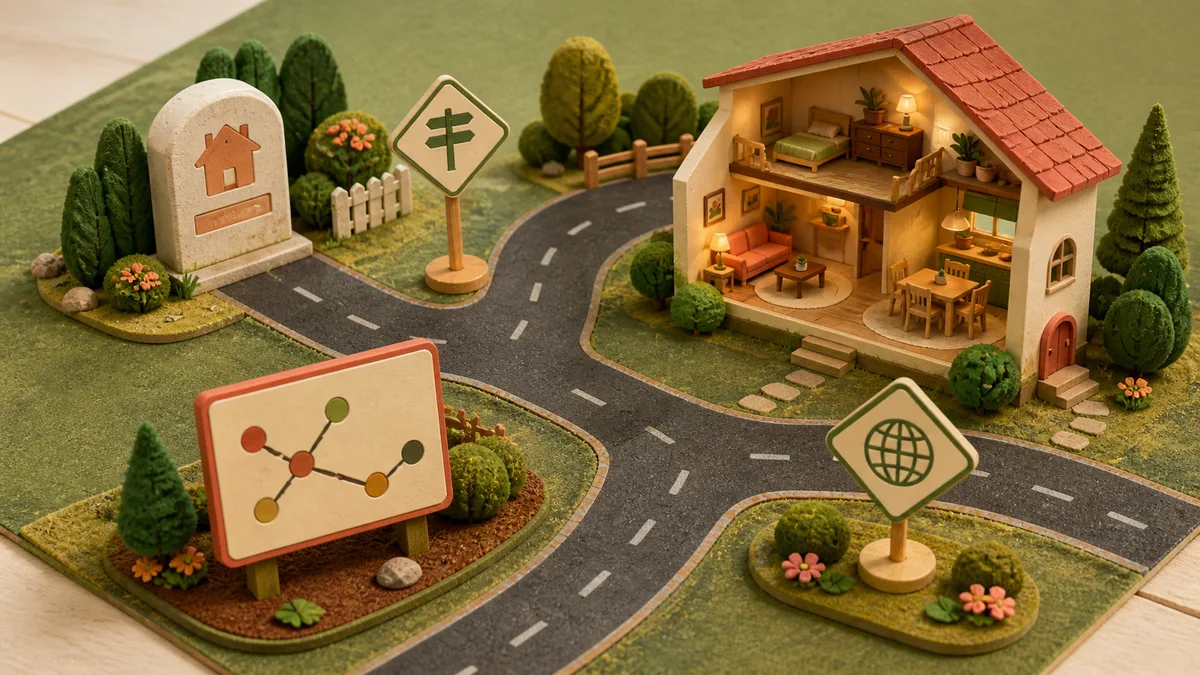
Think of it like a street address
Imagine telling a friend:
“Come over to my house.”
They need an address.
Your website works the same way.
Your domain name is the address people know.
Your website hosting is the place where the website lives.
Your website is what they find when they arrive.
And DNS is a bit like the navigation system that helps everyone get from the address to the right place.
So:
Domain: the address
Hosting: the property
Website: what is there
DNS: the directions
You already understand more of this than you probably thought.
What does a domain actually do?
Suppose you own:
bestcupcakesever.com
Someone types that into a browser.
Their computer asks, in effect:
“Okay, internet. Where does bestcupcakesever.com live?”
DNS helps answer that question and sends the visitor toward the right website.
The same domain can also be used for email:
hello@bestcupcakesever.com
That does not mean your website and email have to live in the same place. They can. They just don’t have to.
That becomes useful later if you ever want to move your website but leave your email exactly where it is.
What are .com, .net, .org, and all those endings?
The ending is called a top-level domain, usually shortened to TLD.
Examples:
.com.net.org.ai.shop
Think of the ending as part of the address.
There are lots of them because different businesses, countries, communities, industries, and ideas can use different endings.
You do not need to memorize them.
Your job is just to pick one that makes sense for the people you want to reach.
Do you actually “own” a domain?
People usually say, “I bought a domain.”
That’s perfectly normal language, and we use it too.
Technically, a domain is more like something you keep registered in your name for a period of time. You renew the registration to keep control of it.
Think of a personalized license plate. You may use it for years, but you still have to keep the registration current.
That is why two prices matter:
Registration price: what it costs to start.
Renewal price: what it costs to keep it later.
Always look at both.
A cheap first year followed by a surprisingly expensive renewal is the domain-name version of a printer that costs $39 and somehow needs $84 ink.
Is a domain the same thing as a website?
Nope.
You can own a domain with no website at all.
You could register:
mybrilliantidea.com
today and decide what to build next month.
You could also use a domain only for professional email or redirect it somewhere else.
The domain is the name. What you connect to it is your choice.
How do I know if a domain name is good?
Forget SEO for a moment and imagine telling the name to another human.
Ask yourself:
- Can they spell it after hearing it once?
- Can they remember it tomorrow?
- Does it look good in an email address?
- Will it still make sense if your business grows?
- Is it easy to confuse with somebody else?
Try saying it out loud.
Then imagine:
yourname@yourdomain.com
If both feel natural, you are probably heading in the right direction.
Do I need keywords in my domain?
Not necessarily.
If a descriptive word fits naturally, great.
But don’t twist a perfectly good business name into something like:
best-cheap-seattle-plumber-services-online-now.com
Nobody wants to type that. Nobody wants it on a business card. And your future email signature will hold a grudge.
Search engines can understand what a website is about from the actual website.
Choose a domain that works for your business and your customers, not one that looks like you tried to stuff a Google search into the address bar.
The part worth remembering
If all the technology words disappear from your brain five minutes from now, remember this:
A domain name is your easy-to-remember address on the internet.
Everything else can be learned when you need it.
And when you’re ready, the next step is simply checking whether the name you want is available.
You’ve got this.
Ready to put a name on your idea?
Search the current domain catalog and see whether the address you want is available.
Search for a domain →